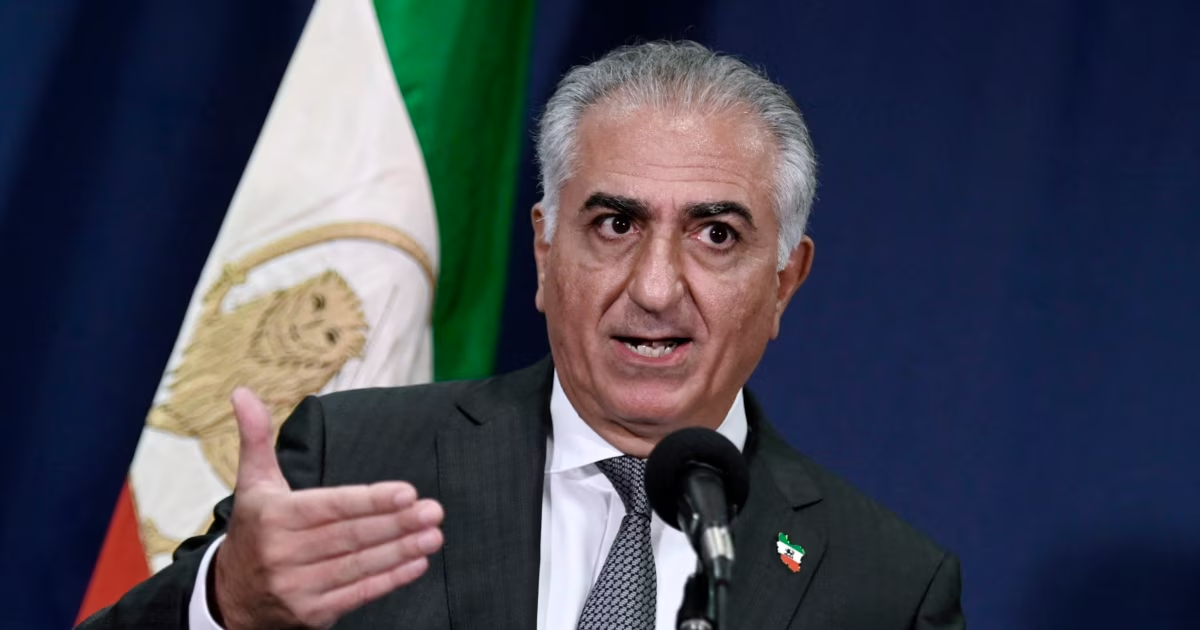
Tehran: Once known as “the world’s richest child,” surrounded by luxury yet marked by loneliness, Reza Pahlavi has unexpectedly become the focal point of Iran’s most intense protests in decades. As nationwide demonstrations that began in late December 2025 continue to escalate, chants calling for the return of Iran’s former crown prince are echoing across the country.
Iran is currently witnessing widespread unrest driven by a deep economic crisis, soaring inflation, the historic collapse of the rial, and growing anger over the Islamic Republic’s repressive policies. What began as protests over prices and livelihoods now appears to be evolving into a broader political movement—one increasingly centered around the name Reza Pahlavi, the eldest son of Iran’s last Shah, Mohammad Reza Pahlavi.
From “Golden Cage” to Exile
Born on October 31, 1960, in Tehran, Reza Pahlavi was declared crown prince at birth. His childhood unfolded amid extraordinary wealth: private palaces, personal aircraft, elite schooling, round-the-clock security, and oil-fueled national prosperity. Yet, despite the privileges, his upbringing was often described as isolated.
A resurfaced magazine clipping from the late 1970s—now widely shared on Iranian social media—famously described him as “the world’s richest child whose only friend is his dog.” At the time, the teenage prince reportedly found companionship mainly in his pet spaniel, Judy, highlighting the emotional cost of a life lived inside a “golden cage.”
The 1979 Revolution and a Life Upended
That privileged life ended abruptly with Iran’s 1979 Islamic Revolution. The Shah was forced into exile, and the monarchy collapsed. Reza Pahlavi, once heir to the Peacock Throne, became a high-profile refugee. Death warrants were issued against his family, and the young prince spent his formative years in exile, primarily in the United States, watching his homeland from afar.
Why His Name Is Rising Again
Between 2023 and 2025, Iran saw repeated waves of protests—most notably following the death of Mahsa Amini—that revealed deep generational anger against strict religious governance. The current demonstrations, which began in Tehran’s Grand Bazaar in December 2025 as a strike against inflation, have since spread nationwide to cities including Shiraz, Isfahan, Mashhad, and several smaller towns.
Despite internet shutdowns and mass arrests, protests have intensified. Casualty figures reportedly run into the hundreds, with thousands detained. The slogans, however, have shifted beyond economic demands to overt political messaging. Alongside chants against Supreme Leader Ayatollah Ali Khamenei, crowds are heard calling: “Reza Shah, rest in peace” and “Prince, come back.”
Reza Pahlavi himself has added momentum through a series of video messages. On January 6, he urged citizens to chant in unison at 8 p.m. local time. Days later, he called for symbolic takeovers of city centers and the display of Iran’s pre-revolutionary lion-and-sun flag, declaring that he intends to return to his homeland. Millions reportedly responded to these calls.
What Is Driving the Support?
Analysts point to several factors behind Pahlavi’s renewed relevance:

-
Economic collapse: Many Iranians nostalgically recall the Shah-era economy, when oil revenues fueled development and the currency was stable.
-
Fatigue with religious rule: A young, Gen Z-led population increasingly rejects compulsory religious laws, including mandatory hijab, and aspires to a secular, modern Iran.
-
Leadership vacuum: Iran’s opposition remains fragmented, leaving Reza Pahlavi—now 63—as a recognizable, unifying figure and symbol of a “lost golden era.”
Not a Call for Monarchy—At Least Not Officially
Support for Pahlavi is not universal. Critics argue that repression, inequality, and the notorious SAVAK secret police defined the Shah’s rule. Some protesters chant “Neither Shah, nor cleric.” The Iranian government has dismissed the unrest as a foreign-backed conspiracy involving the US and Israel.
Notably, Reza Pahlavi himself has distanced his movement from restoring monarchy. In recent interviews, he has emphasized that he is not seeking the throne but advocating for democracy.
“I don’t want power,” he has said. “I want Iranians to have the right to choose.”
That stance marks a transformation—from a lonely, privileged teenager to a political figure many now see as a mature symbol of transition rather than rule.
As protests continue and Iran stands at a crossroads, one question dominates the national conversation: is the country witnessing the return of a man—or the resurrection of an idea?